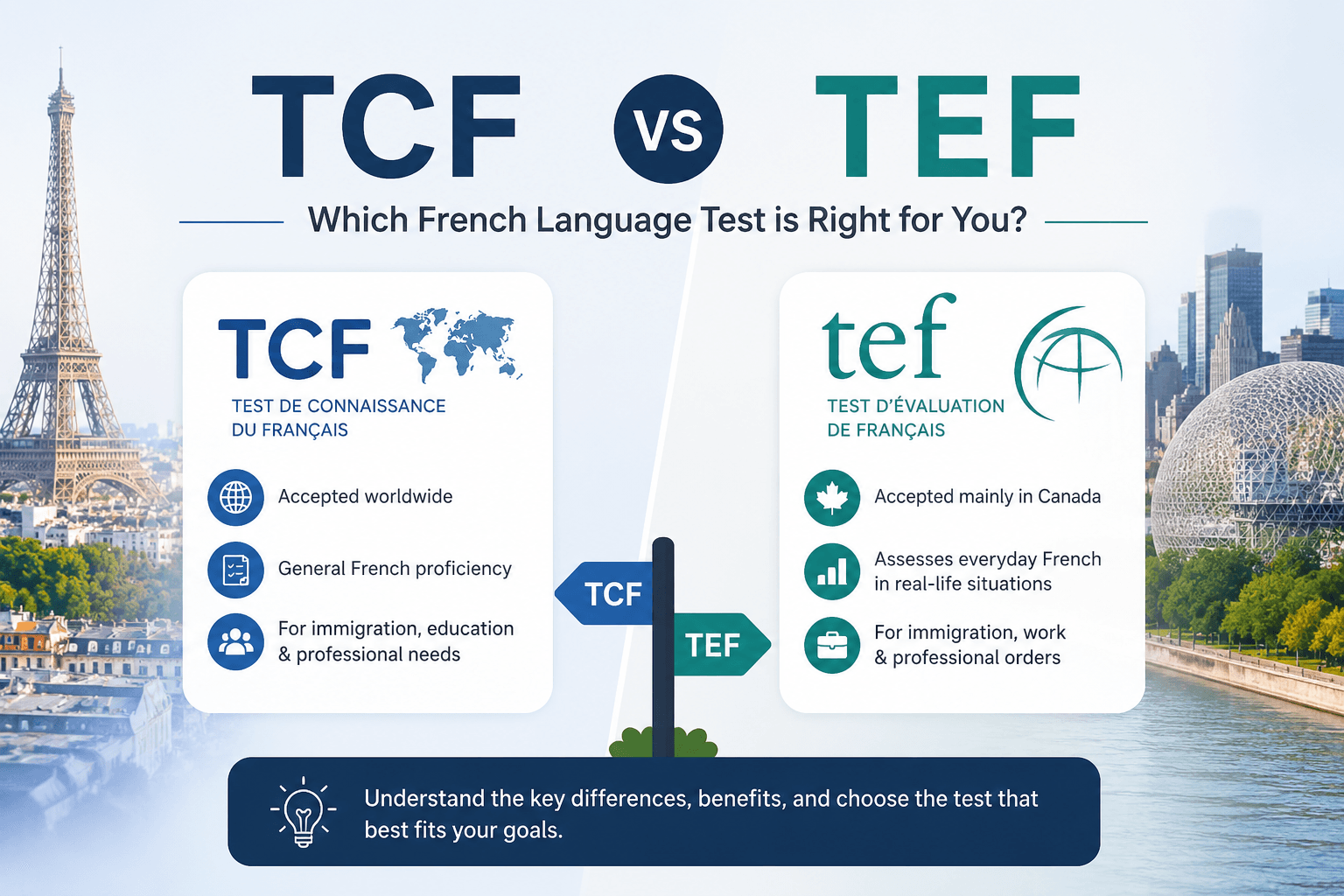
If you're applying for Canadian permanent residency, French citizenship, a long-stay visa, or admission to a French-speaking university, you've probably hit the same wall everyone hits: you need to prove your French level with an official test. And the two names you keep seeing are TCF and TEF.
They look almost identical from the outside. Both are official, both align with the CEFR scale, both test the same four skills, and both are accepted by basically every authority that asks for proof of French. So which one do you take?
Below is what actually separates them, and how to choose the one that fits your situation.
What each acronym actually means
TCF stands for Test de Connaissance du Français. It's developed and administered by France Éducation International, an institution under the French Ministry of National Education. Think of it as the "official" test backed directly by the French government's education arm.
TEF stands for Test d'Évaluation de Français. It's run by the Chambre de Commerce et d'Industrie de Paris Île-de-France (CCI Paris), yes, the Paris Chamber of Commerce. It was originally built with a more professional, business-oriented lens, though today it serves almost every purpose the TCF does.
That difference in parentage is the root of nearly every other difference between the two.
What they have in common
Before getting into the differences, it's worth being clear about how similar these tests really are:
- Both assess the same four skills: listening, reading, writing, and speaking.
- Both map results to the CEFR levels, from A1 (beginner) to C2 (mastery).
- Neither has a "pass" or "fail"; you simply receive a level.
- Both certificates are valid for two years from the date of the exam.
- Both are recognized by Immigration, Refugees and Citizenship Canada (IRCC), by French préfectures for residency and naturalization, and by most French and francophone universities.
- Both are open to anyone over 16, whatever your native language.
So if you have solid French, either one will, in principle, get the job done.
Where they actually differ
1. Test structure and length
This is the most practical difference. The TEF is shorter overall, roughly two hours for the core modules, while the TCF runs closer to three hours.
| Skill | TEF | TCF |
|---|---|---|
| Listening | 40 questions / 40 min | 39 questions / 35 min |
| Reading | 40 questions / 60 min | 39 questions / 60 min |
| Writing | Formal tasks from the start | Progressive (easy to hard) |
| Speaking | Multiple tasks, rising difficulty | Multiple tasks, rising difficulty |
The takeaway: if you're a fast worker who likes momentum, the TEF's compact format may suit you. If you prefer to warm up before tackling harder material, the TCF's progressive design tends to feel friendlier.
2. Modularity
The TEF is modular. You can sign up for only the modules you need, and if you bomb the writing section but ace everything else, you can retake just that one piece. The TCF is more rigid: most versions are taken as a complete block.
For people retaking a test to chase a specific score (very common for Canadian Express Entry candidates trying to push a CLB level higher), this flexibility matters a lot.
3. Versions for specific purposes
Both tests come in multiple flavors targeted at different goals:
- For Canada: TEF Canada and TCF Canada. Both are accepted by IRCC for Express Entry, PNPs, and citizenship. Score conversion to Canadian Language Benchmarks (CLB) works for both.
- For French residency and naturalization: TEF IRN and TCF IRN (Intégration, Résidence et Nationalité). Streamlined versions that test only the skills required by French immigration law.
- General purpose: TCF tout public and the standard TEF, used for university admission, employment, and personal certification.
Pick the version that matches your end goal, not the general one, or you risk paying for a certificate that doesn't satisfy the authority you're applying to.
4. Scoring feel
Both produce CEFR levels, but the underlying approach differs. The TEF gives you a numerical score on a sliding scale that's converted to a CEFR level. The TCF gives you a level directly per skill. In practice, candidates often report that one test "feels" easier than the other depending on their strengths: the TEF can reward quick thinkers, while the TCF's progressive structure favours a steadier, more methodical style.
5. Cost and availability
Pricing varies by country and test center, but the TEF generally costs slightly more than the TCF, especially when you add modules. Availability also depends heavily on where you live: in some cities one test runs weekly while the other only runs once a month. Always check what's actually scheduled near you before deciding.
So which one should you take?
A simple way to decide:
- Going to Canada for immigration? Both work. Pick the one with better availability and pricing where you live. If you suspect you'll need to retake a section, lean toward the TEF for its modularity.
- Applying for French residency or nationality? Take the IRN version (TEF IRN or TCF IRN). Either is accepted; choose based on test-center proximity.
- Applying to a French university? Check the institution's preference, since some explicitly list one or the other. When both are accepted, the TCF is often the safer default given its direct affiliation with the French Ministry of Education.
- Job application in France or a francophone country? The TEF has a slight historical edge in professional contexts thanks to its CCI Paris origins, but in 2026 either is widely accepted.
A final word
Don't overthink the choice. The single biggest predictor of your score isn't which test you pick. It's how well you prepare for the format of that specific test. Pick one, get familiar with its question types and timing, and put your energy there.
If you're heading for the TCF Canada, that's exactly what TCF Run is built for: full AI-generated mock exams in the real format, instant CLB-aligned scoring, and AI feedback on your writing. Try a free mock exam and see where you stand in 50 minutes.